The Signal Above the Veneer: Why Cabin Wi-Fi Now Decides the Aircraft
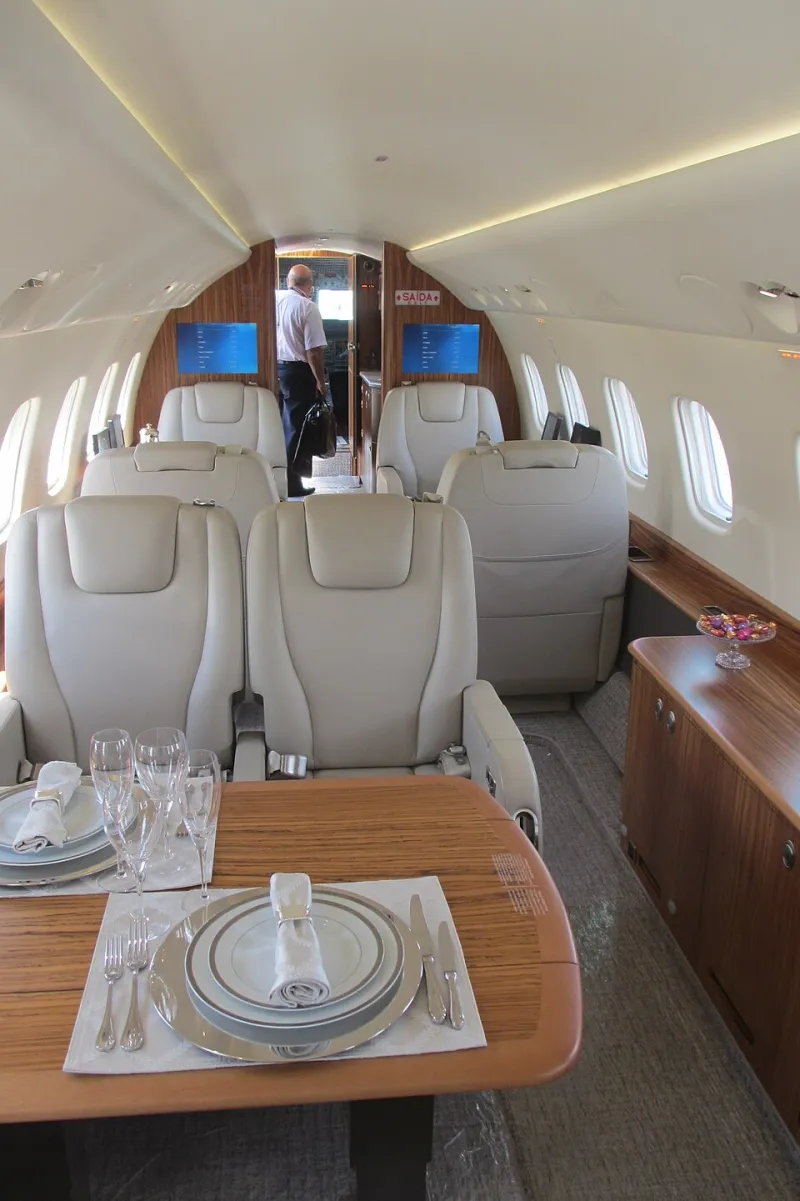
Photo: JetRequest.com, CC BY-SA 3.0, via Wikimedia Commons
Walk through a private jet cabin and the eye goes to the obvious things: the leather, the veneer, the gleam of the galley. The business traveler looks past all of it. The first question is no longer whether the aircraft has Wi-Fi. It is whether the Wi-Fi will support a video call, a VPN, and a shared screen at the same time — at altitude, over the route being flown. In 2026, that question decides which aircraft gets chosen.
From Amenity to Infrastructure
Connectivity used to be a novelty, the kind of feature an operator mentioned after the entertainment system and before the espresso machine. It is now infrastructure. A cabin without reliable bandwidth is a beautiful room that cannot host work. For a traveler whose schedule depends on staying reachable, the difference between a usable link and a thin one is more consequential than the color of the stitching.
This is not a matter of taste. It is a matter of arithmetic. A flight of three hours is three hours of potential work, negotiation, or decision-making. If the connection cannot carry a voice call without breaking, the cabin has effectively imposed a blackout. The aircraft may be luxurious. It is still the wrong aircraft for that passenger on that day.
The Satellite Behind the Signal
Most cabin connectivity depends on a satellite link, and the link is only as good as the system behind it. Ku-band and Ka-band services offer broader bandwidth but can be affected by weather and coverage contours. L-band services are narrower but resilient. Low-earth-orbit constellations promise lower latency and a more responsive experience, while air-to-ground systems can work well over land but leave gaps over water and remote terrain. Each architecture carries trade-offs that do not appear in a brochure.
The hardware inside the cabin matters as much as the satellite outside it. An aircraft may have an antenna, a router, and access points, but the generation of that equipment determines what the passenger actually experiences. An older system can advertise Wi-Fi and still deliver a connection that struggles with a single video call. A newer system can support multiple devices, secure tunnels, and cloud-based work — if the aircraft is equipped for it and the operator has provisioned enough bandwidth.
What Wi-Fi Equipped Really Means
Equipped is not a standard. It is a claim. The useful questions are more specific. Which system is installed? Which generation? What are the typical download and upload speeds? What is the latency? How many devices can be supported without degradation? Is there a data cap, and who pays for overages? Are streaming and video conferencing permitted, or merely tolerated?
A passenger should also ask whether the service is included in the quote or metered separately. Some operators bundle connectivity into the charter price. Others pass through data costs, sometimes at rates that surprise the client after landing. Neither approach is inherently wrong. The mistake is assuming that Wi-Fi on the equipment list means bandwidth on the flight.
The Coverage Gaps Nobody Mentions
The route matters. A system that performs well over the continental United States may behave differently over open water, mountainous terrain, or northern latitudes. Satellite handoffs can cause brief interruptions. Weather can degrade the signal. Even the phases of flight matter: taxi, takeoff, and landing may impose restrictions on antenna use or cabin electronics.
These gaps do not make connectivity useless. They make planning necessary. A passenger who needs to join a critical video call should know whether the route and the aircraft support it. A passenger who needs to send a few documents and clear an inbox has a lower threshold. The aircraft should be matched to the work, not chosen on the strength of a logo on the bulkhead.
A Buyer's Checklist for Bandwidth
Ask which satellite or air-to-ground system the aircraft uses. Ask for realistic speeds, not peak figures. Ask about latency and whether real-time applications are supported. Ask how many passengers can work at once. Ask whether the service is redundant. Ask what happens if the primary link fails. Ask whether the operator can provide a recent speed test from the same aircraft and route.
Then ask the simplest question of all: can I test it before I book? An operator who knows the aircraft performs well will welcome the question. An operator who deflects it has told the passenger something useful.
The New Cabin Hierarchy
Leather is table stakes. Veneer is a matter of taste. Connectivity is now the feature that separates a cabin that looks the part from one that supports the life of the person inside it. The most valuable aircraft in the charter market is not always the newest or the most lavishly finished. It is the one whose signal holds at altitude, whose bandwidth survives the workday, and whose operator understands that the quietest luxury is the connection that simply works.