Every Ounce Is Negotiable Until It Isn't: Packing for a Private Flight Without the Surprises
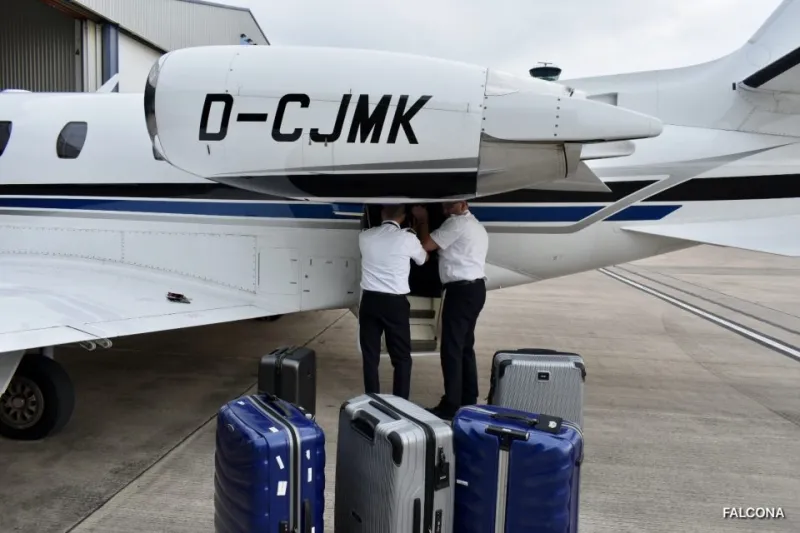
Photo: private jet baggage loading luggage ramp, via falconaprivatejets.com
There is a moment, usually on the ramp, when a charter passenger learns the difference between what a jet can carry and what a jet can carry comfortably. The skis go in — barely. The golf travel bag goes in the closet that was supposed to hold the garment bags. The dog looks up hopefully. And somewhere in the flight department, a dispatcher is redrawing a weight-and-balance computation that was finalized three days ago.
Private aviation sells freedom, and for the most part delivers it. But the physics of a pressurized cabin at 43,000 feet are indifferent to marketing. Every pound aboard — passengers, pets, luggage, fuel — must be accounted for, and the arithmetic is done before you ever arrive at the FBO. Understanding it in advance is the difference between a seamless departure and an uncomfortable conversation on the ramp.
The Sheet Nobody Sees
Before every charter flight, the operator completes a weight-and-balance calculation. It is not a formality. Aircraft have hard structural limits on maximum takeoff weight, and a subtler constraint on where that weight sits along the fuselage. A cabin loaded too far aft can push the center of gravity outside the certified envelope, which affects handling at rotation and in cruise.
In practice, this means your charter operator needs an honest passenger count and a reasonable estimate of baggage well before departure. Six adults with heavy luggage in a midsize jet is a different aircraft, aerodynamically speaking, than six adults traveling light. A responsible operator will ask. A great one will ask early — and tell you plainly when something doesn't work.
The practical consequence: your packing list is part of the flight plan. Treat it that way.
What Actually Fits, Aircraft by Aircraft
The industry's category names — light, midsize, super-midsize, heavy — describe range and cabin height, but they also describe cargo reality. Here is the honest version.
Light jets (think Phenom 300, Citation CJ3 class): Baggage capacity runs roughly 50 to 65 cubic feet, and it is shaped awkwardly — a external hold plus a modest internal closet. Golf bags fit, but usually two, not four, and skis are often out of the question unless they are short or the bags are soft-sided. This is the aircraft for two couples heading to Napa with a weekend's worth of luggage, not a family of five with winter gear.
Midsize and super-midsize (Citation Latitude, Praetor 600 class): This is where the math starts working for most American missions. Ski cases for four fit the external hold of a Latitude on the Aspen run. Golf bags for four fit a super-mid on the way to Scottsdale or Kiawah. The internal closet still holds garment bags and the stroller you decided to bring at the last minute.
Heavy jets (Gulfstream G450 and up, Challenger 604 class): Cargo ceases to be the constraint. A transcontinental flight to Palm Beach with skis, golf clubs, wine, and a large dog is a solved problem. The constraint moves to the weight of the fuel you're carrying — a coast-to-coast leg with full tanks leaves less margin for baggage than the same aircraft flying New York to Florida.
The Dog in the Cabin
Pets are one of the great advantages of charter flying, and one of the most misunderstood logistics items. Nearly all US charter operators will fly dogs and cats in the cabin, uncrated, if they are well-behaved — but policies vary meaningfully. Some operators require a health certificate dated within ten days of travel. Some charge a pet fee. A few restrict cabin pets on longer legs or when other passengers on a shared charter have allergies.
The unsung variable is size. A 25-pound cockapoo on the cabin floor is a non-event. An 80-pound Bernese Mountain Dog needs floor space that a light jet simply doesn't have, and a large dog on a super-midseat is a conversation with the operator, not a given. Ask when you book, not when you board. And bring the certificate, the leash, and a plan for the first stop — a dog that has held it for four hours will need the grass at the FBO before it needs the cabin.
Skis, Clubs, Strollers, and Cases of Wine
A few category-specific notes that save grief:
- Ski equipment: Hard-shell ski cases protect the gear but eat cubic feet. Soft bags are more forgiving. One pair of skis, poles, and boots is roughly the volume of two duffel bags. For a Vail or Aspen trip on a midsize, confirm ski capacity explicitly — it is the single most common baggage surprise in American charter.
- Golf travel bags: With the clubs, a loaded travel bag runs 40 to 50 pounds. Four of them is 200 pounds of hold space and weight budget. Super-mids and heavies handle it; lights often don't.
- Strollers and car seats: Gate-check them with the FBO ramp crew — they go in the hold, and they come out at the aircraft door, not a carousel.
- Wine: A case is 40-plus pounds and fragile. Cabin stowage in an internal closet is ideal; the external hold on many jets is unpressurized and, in winter, cold enough to matter. Tell the operator in advance.
The Route Reshapes the List
The same passenger, with the same luggage, will have a different experience depending on the mission. Denver to Eagle County in a light jet in January is a tight cargo proposition — skis push the limits, and a full fuel load for the mountain approach eats weight margin. Teterboro to Palm Beach in a super-mid is the opposite: abundant hold space, but a long leg means heavy fuel, and the baggage allowance quietly shrinks by a bag or two.
This is the conversation a good charter partner has with you at booking. At JetBook K12, the quote process asks about passengers, pets, and equipment precisely so that the weight-and-balance sheet is a formality rather than a negotiation. When you list the dog, the skis, and the golf bag up front, the operator selects the right aircraft — and the ramp moment becomes what it should be: a door, a step, and a departure.
Bring what you want. Just tell someone first.