Who Sits Where Before Anyone Asks: The Unwritten Floor Plan of the Private Cabin
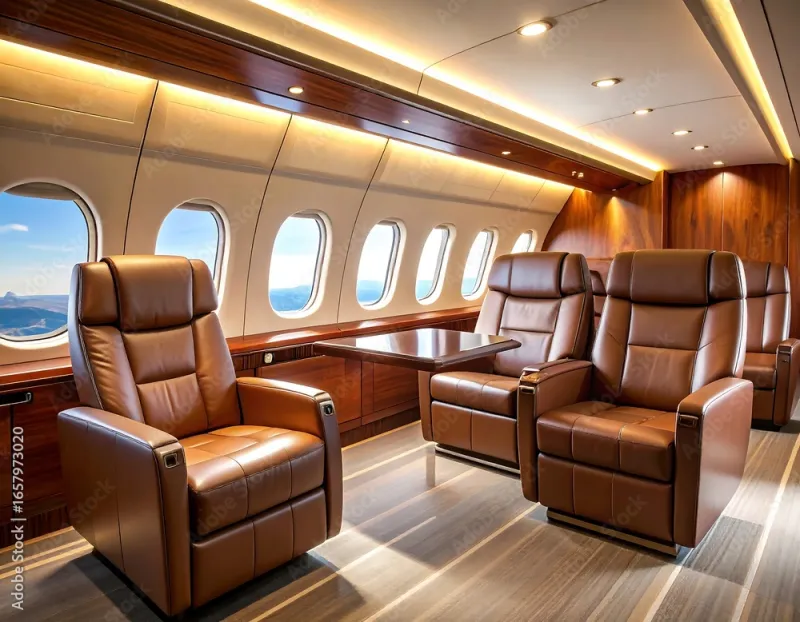
Photo: luxury private jet cabin interior club four seating leather, via as1.ftcdn.net
Board a commercial flight and the seat map is a transaction: 14A, 21C, an aisle for the tall, a window for the sentimental. Board a private aircraft and there is no map at all — no assignments, no boarding groups, no overhead bin scramble. And yet within ninety seconds of stepping onto the ramp, everyone aboard has settled into a position that would be familiar to an anthropologist.
The private cabin does not announce hierarchy. It simply makes some seats more natural to take than others, and lets the passengers do the rest.
The Club Four and the Fiction of Equality
The dominant configuration in American charter — the club-four, two facing pairs behind the wing — presents itself as pure democracy. Four identical chairs, equal leather, equal legroom, everyone in conversation's easy reach. It is the layout of equals, and for many missions it genuinely is: a family returning from Vail, four partners flying to a closing in Chicago.
But designers will tell you the club-four is not neutral. Facing seats create a social contract. Sit across from the person who signs your paychecks and you will spend two hours in sustained eye contact, or studiously avoiding it. Sit beside them and the dynamic softens into something closer to a shared errand. Charter brokers say they watch clients scan the cabin the way diners choose a restaurant table — and that the person who boards last usually inherits the seat across from the most senior passenger, whether anyone intended it or not.
The Divan Problem
Then there is the divan — the long upholstered sofa that runs along one side of many light and midsize jets. Brochure photography loves it: a child stretched out with a tablet, a spouse reading, a golden retriever looking photogenic. In practice, seasoned fliers describe the divan differently. It is the seat without a seatback, the place where turbulence is felt most, the spot that doubles as overflow when the manifest grows.
"Nobody assigns the divan," one New York-based broker puts it. "It assigns itself. The most junior person on board ends up there, and everyone pretends it was about the view out the left side."
Cabin designers are candid about the trade-off. Divans buy berthing flexibility and a sense of residential ease that individual chairs cannot match. But in a cabin full of adults, the sofa reads as secondary seating — which is precisely why some owners of large-cabin aircraft have begun ordering layouts with no divan at all.
The Aft Cabin and the Forward Bubble
On heavy jets — a Gulfstream G550, a Bombardier Global, a Falcon 7X — the floor plan becomes an explicit map of precedence. The forward club-four belongs to the principals. Mid-cabin, a second seating zone or conference grouping absorbs staff, advisors, and guests of guests. The aft stateroom, with its full berthing and private lavatory, is the owner's domain, and everyone aboard understands that the curtain at the end of the aisle is a border.
What surprises first-time charter clients is how much of this they absorb without instruction. Interviews with interior design firms serving the American market reveal a consistent brief: the cabin must allow a principal to move from seat to stateroom without crossing anyone's conversation, and it must give the most senior passenger sight lines to the galley and the door — not because service depends on it, but because awareness does.
Reading a Floor Plan Like a Manifest
For charter clients, the practical takeaway is simple: request the interior layout before you confirm the aircraft, and read it the way you would read a dinner seating chart.
- A single club-four suits four peers; six passengers on the same airframe means someone is riding on the divan, literally or socially.
- A forward galley with an open bulkhead keeps crew in the conversation; a closed one keeps the cabin quiet — know which you want.
- If the mission includes both principals and staff, a second enclosed zone or at minimum a defined mid-cabin group preserves everyone's comfort.
- For overnight transcons or flights to Hawaii, berthing configurations matter more than wood veneer; ask how many sleep flat and where.
Brokers at JetBook K12 routinely send floor plans alongside quotes, and clients who study them tend to report smoother trips. Not because the leather was softer, but because nobody spent the flight in the wrong chair.
The Quietest Form of Etiquette
There is no card in the seat pocket explaining any of this. No one will tell a guest not to take the aft stateroom or a colleague not to settle onto the divan beside the CEO. The cabin relies on what it has always relied on: attention, precedent, and a shared understanding that in a space this small, position is language.
The engines will start on time either way. But the passengers who read the floor plan before they board — and the operators who design cabins worth reading — understand that on a private flight, the seating chart is the first conversation of the trip.